Scientific Traces of the Ramayana: Bridging Myth and History
The Ramayan, one of the most revered epics in Indian tradition across generations as an epic of divine love, duty, and valor, has always been perceived as mythology — rich in divine heroes, cosmic wars, allegory and spirituality. But in recent decades, researchers, archaeologists, and scholars have begun to explore a more provocative possibility: Could the Ramayana be more than just mythology? Could it be a historical narrative encoded in allegory, poetry, and spiritual symbolism?
In this blog driven by both reverence and curiosity, I undertake a journey not of belief alone, but of inquiry — seeking scientific, archaeological, geographical, cultural, linguistic and astronomical insights that could validate the age-old story of Ramayan. This exploration does not aim to diminish its spiritual value or strip the epic of its divinity, but to bridge the gap between myth and history — between the poetic and the provable.
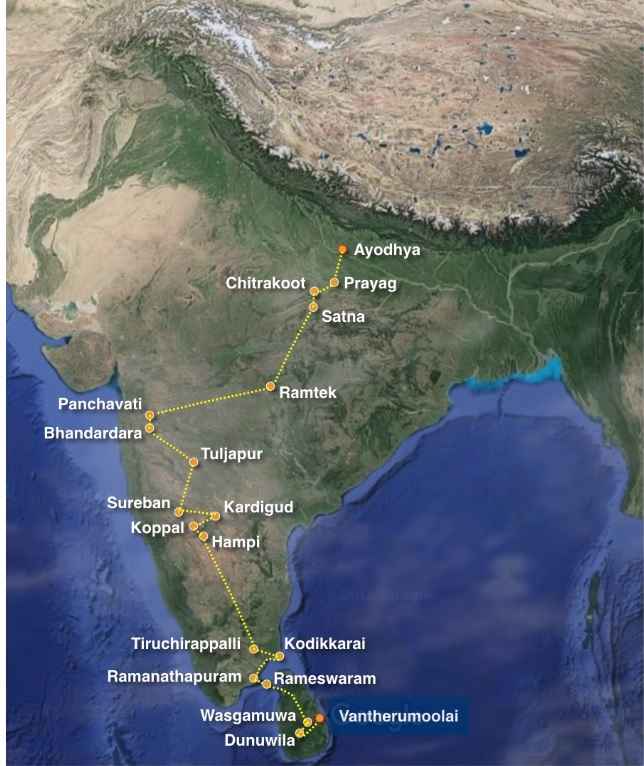
Geographical Realism: Tracing the Journey
- Ayodhya (Uttar Pradesh): Described as the birthplace of Ram and the capital of Kosala, Ayodhya exists today not just a spiritual center but an archaeological site with historical relevance. Excavations conducted by the Archaeological Survey of India (ASI) have uncovered remains of ancient structures beneath the Ram Janmabhoomi site dating back to several centuries BCE. The Sarayu River continues to flow by Ayodhya, just as described in the epic.
- Mithila (Janakpur, Nepal): The birthplace of Sita, Mithila still holds a strong cultural identity rooted in Ramayana traditions. Its location, its fertile lands, and its proximity to rivers like Gandak aligns with real topographical features. The Janaki Temple stands in honor of Sita, and rituals from her swayamvar are reenacted annually.
- Dandakaranya Forest (Central India): Spanning across Chhattisgarh, Odisha, and Maharashtra, this dense forest region fits descriptions of the forest in which Rama, Sita, and Lakshmana lived during exile. The dense forests, hilly terrain, and rocky formations match the terrain described during Sita's abduction and Rama’s search for her.
- Kishkindha (Hampi, Karnataka): Identified as the monkey kingdom, Hampi’s terrain mirrors Valmiki’s description. Anjaneya Hill is revered as Hanuman’s birthplace.
- Rameswaram to Lanka: The southernmost part of India aligns with the path taken to Ravan’s kingdom, famously traversed by Rama, Lakshmana, and Hanuman, also shows signs of consistency with current geography. This journey culminates in the famed Ram Setu.
- Sri Lanka: In Sri Lanka, folklore, geography, and cave systems align with descriptions from the Ramayana. Sites like Sigiriya, Sita Kotuw, Ravan Ella Falls, and Ashok Vatika match the epic's narrative. Though direct evidence of Ravana’s rule remains elusive, the oral histories and traditional belief systems of Sri Lanka echo with references to the epic’s events. Ancient cave structures and tools found in the region further support the idea of advanced settlements.
The Mysterious Rama Setu: An Engineering Marvel or Stones That Whisper Stories?
Astronomical Dating: Mapping the Skies of the Past
- Dr. Pushkar Bhatnagar’s Study: Using Planetarium Gold software, Dr. Bhatnagar recreated the skies matching the planetary positions in Valmiki’s text to Rama’s birth. According to their findings, the alignment of stars and planets described during Rama’s birth corresponded to a date around January 10, 5114 BCE.
- Solar and Lunar Eclipses: Verses describing solar eclipses during pivotal events — like Sita’s abduction or the war in Lanka — correlate with actual eclipse paths of the period.
Cultural Continuity: Traditions Across Time
- Ramleela Performances: Annual reenactments of the Ramayana across India and Southeast Asia maintain the storyline, characters, and even dialogue from the ancient text.
- Temple Architectures: Many temples in India and Southeast Asia (Indonesia, Thailand, Cambodia) contain murals and carvings of Ramayan episodes, suggesting its wide cultural influence.
- Place Names: Cities, rivers, and hills still carry names from the epic — like Chitrakoot, Panchavati, and Sitanadi — preserving its legacy in daily geography.
Literary and Linguistic Evidence: Echoes in Ancient Texts
- Valmiki’s Ramayan: Composed in classical Sanskrit, the Ramayan’s internal consistency and geographical detail suggest a narrative based on oral history or firsthand observation. Linguistic analysis shows that its style matches early Sanskrit used around 1500–1000 BCE.
- References in Other Texts: The Ramayan is mentioned in the Mahabharat, Vedas, and various Puranas. This intertextual reference strengthens the idea of its importance beyond mythology.
- Southeast Asian Versions: From the Kakawin Ramayana of Java to the Hikayat Seri Rama in Malaysia, regional adaptations carry linguistic and thematic parallels, indicating a common origin.
Scientific Curiosities: The Floating Stones
- Pumice Theory: Scientists suggest these could be pumice stones, formed from volcanic activity, which naturally float due to air pockets.
- Ancient Engineering: Others argue that even if the stones are natural, their deliberate placement suggests ancient engineering knowledge far ahead of its time.
Comments
Post a Comment